
 English
 русский
 Français
 Español
 Português
 عربى
عربى

-


Model:
-

Model:
-

Model:

Shearing Machine: Types, Selection & Buying Guide
2026-07-31
Content
When a fabrication shop requires sheet metal cut to a consistent 0.1 mm tolerance across thousands of parts, the difference between a machine that pays for itself in six months and one that creates a bottleneck often comes down to the shearing machine’s design, drive system, and build quality. Selecting the right shear shapes not only edge quality but also throughput, maintenance intervals, and the range of materials a plant can process profitably.
This guide walks through the core working principles, the major categories of shearing machines, the essential selection criteria, and the ownership factors that experienced production managers evaluate before a purchase.
How a Shearing Machine Cuts Metal
Every shearing machine operates on the same fundamental action: two blades pass each other with a controlled gap to induce fracture in the workpiece. The upper blade, driven by a mechanical or hydraulic system, descends in a straight or rocking motion while the lower blade remains fixed. The material is clamped on both sides of the cut line to prevent shifting, and the blade gap—typically 5 % to 10 % of material thickness—is set to produce a clean separation without excessive burr.
The quality of the cut depends more on blade clearance, rake angle, and hold-down force than on raw tonnage. A well-adjusted shear consistently produces edges that require little secondary finishing, while an undersized or poorly maintained machine generates burrs, camber, and twist that cascade into downstream problems in bending or welding.
Two motion patterns dominate the market: guillotine action, where the upper blade moves vertically with a fixed rake angle, and swing‑beam action, where the upper blade pivots. Guillotine designs allow the upper and lower blades to remain parallel throughout the stroke, delivering straight edges on thicker plate. Swing‑beam machines, more common in lighter‑gauge units, arc through the cut, which can produce a slightly angled edge but simplifies the mechanical linkage.
Types of Shearing Machines
The market segments shearing machines primarily by their drive system and frame architecture. Each type targets a specific window of material thickness, production volume, and capital budget. Understanding the trade‑offs is essential for matching a machine to real workloads.
Mechanical Shears
A flywheel stores energy in a mechanical shear, and a clutch engages the crankshaft or eccentric drive to force the blade through the material. Mechanical shears cycle rapidly, often exceeding 50 strokes per minute, making them suitable for high‑volume, light‑gauge work. However, their fixed stroke length means they deliver full force only at a specific crank angle, and the cutting force available decreases as the blade advances. They excel when throughput matters more than plate thickness, typically in gauges up to 3 mm mild steel.
Hydraulic Shears
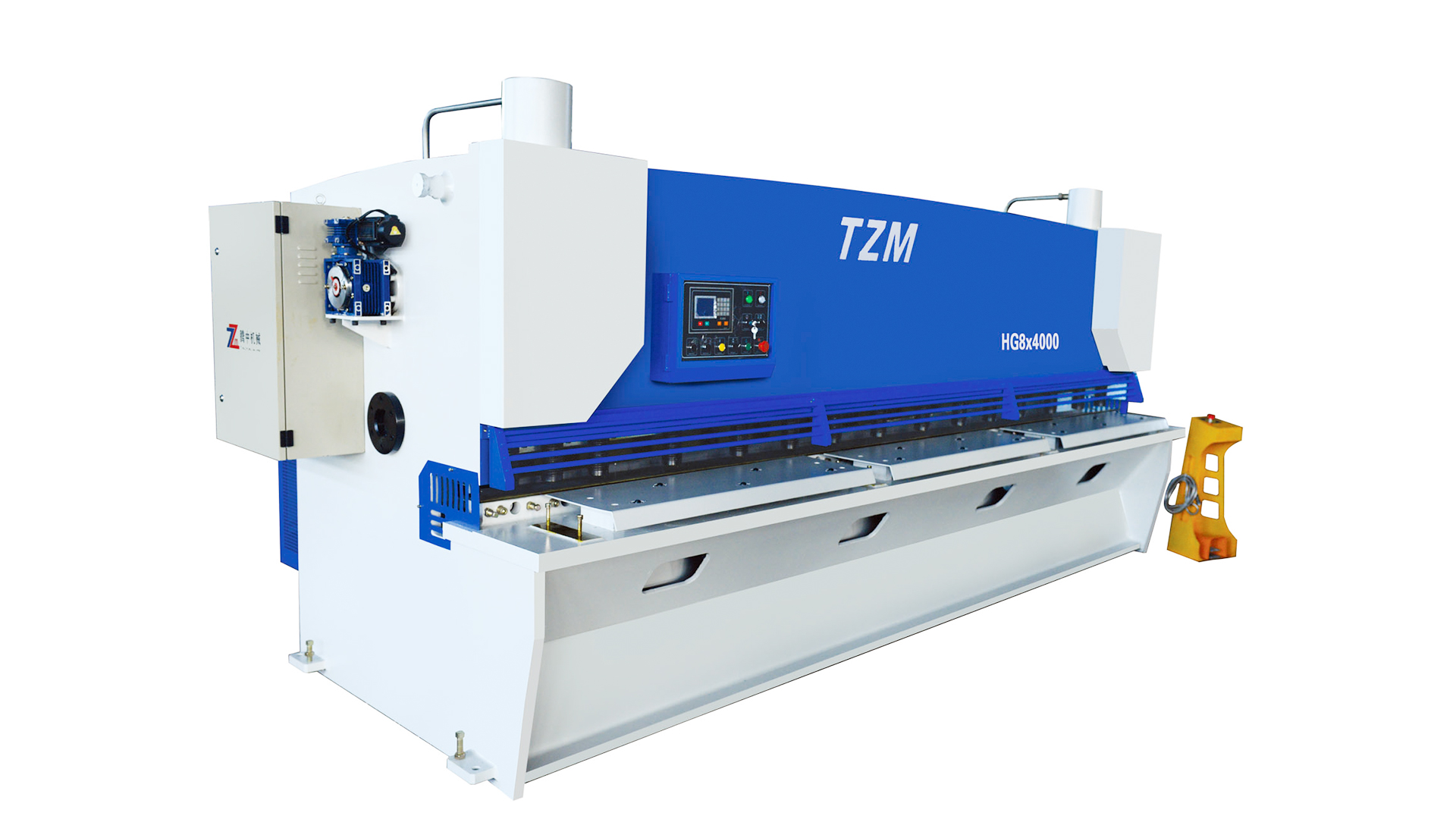
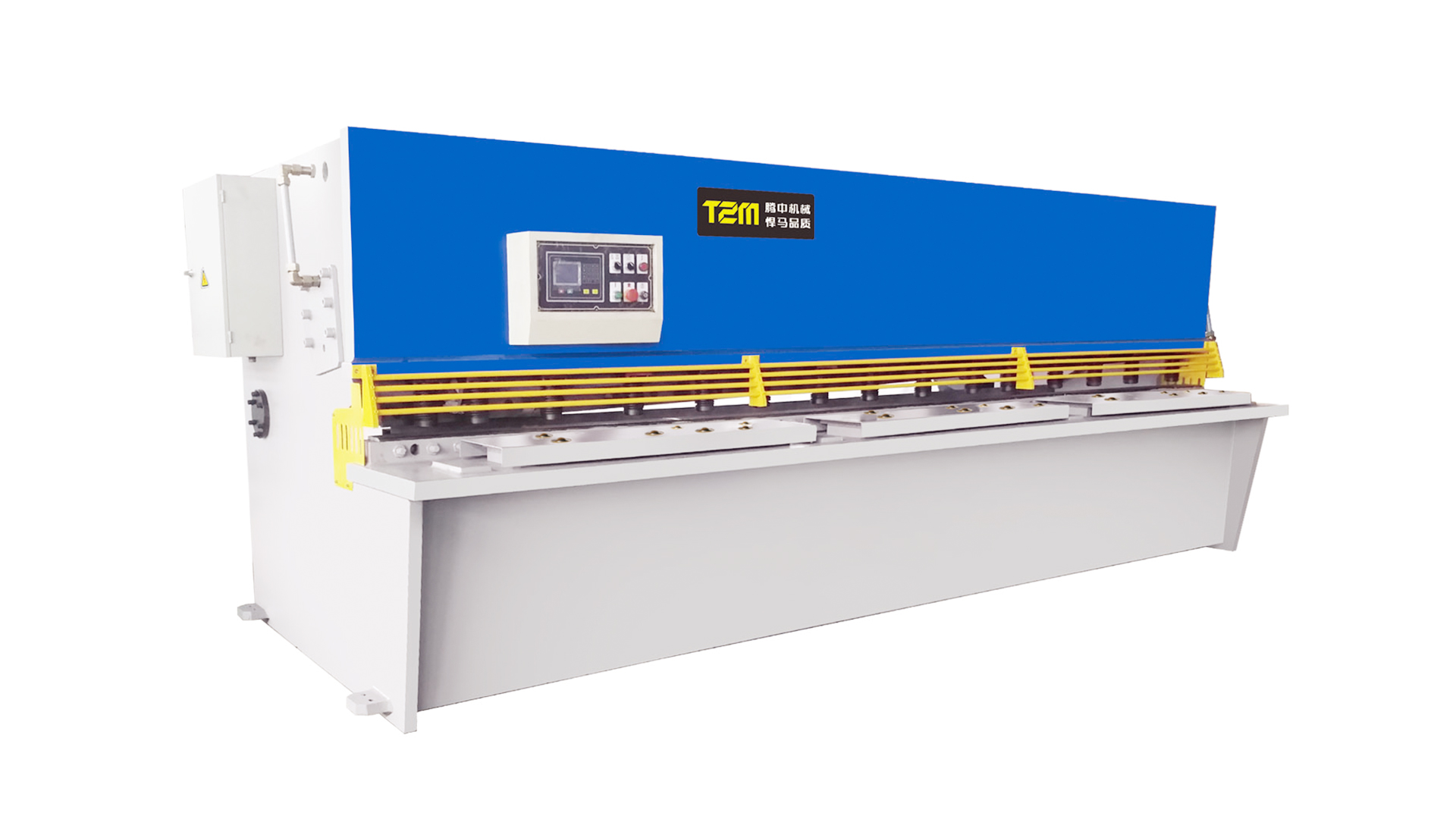
Hydraulic cylinders drive the ram in a hydraulic shear, providing full cutting force from the moment the blade contacts the material. This constant torque characteristic lets a hydraulic shear handle thicker plate—often 20 mm and above—without overloading the drive. Stroke length, rake angle, and return speed can be adjusted via the CNC or manual controls, improving versatility. Cycle times are slower than mechanical equivalents, but the ability to set an optimal rake angle for each material grade reduces twist and improves straightness. For job shops processing mixed thicknesses daily, a hydraulic shear usually offers the best return on investment.
Guillotine vs. Swing‑Beam Frames
Guillotine shears use a four‑bar linkage or linear guides to keep the upper blade carrier moving perfectly vertically. This eliminates the arcing cut of a swing‑beam machine and produces a dead‑straight edge even on thick plate. Swing‑beam shears pivot the upper blade from a rear hinge point, which simplifies manufacturing and reduces cost but may require a larger rake angle to achieve acceptable straightness. Most modern high‑accuracy hydraulic shears for plate above 6 mm adopt a guillotine frame.
CNC‑Controlled Shears
CNC backgauges and automated blade‑gap adjustment transform a conventional shear into a high‑precision system. Operators program cut sequences, including sheet squaring, multiple cuts, and retract positions, directly on the controller. Motorized blade‑gap adjustment, driven by material thickness input, reduces setup time and eliminates guesswork. In batch production environments, a CNC shear can reduce labor cost per part by 30 % or more compared to a manual backgauge machine.
| Feature | Mechanical | Hydraulic | CNC Hydraulic |
|---|---|---|---|
| Max. thickness (mild steel) | Up to 3 mm | Up to 30 mm | Up to 25 mm |
| Cycle speed | 40–60 SPM | 8–20 SPM | 10–22 SPM |
| Edge straightness | Good | Excellent | Excellent |
| Setup time | Manual | Manual / powered | Automatic |
| Ideal application | High‑volume light gauge | Mixed plate thickness | Batch production, tight tolerances |
Key Selection Criteria for a Shearing Machine
Evaluating a shear on a spec sheet alone often leads to under‑specifying the machine for real operating conditions. The most expensive mistake buyers make is not matching the machine’s rated capacity to the thickest material they actually process, including any localized hard spots or high‑strength alloys. The criteria below separate a reliable production asset from a recurring service headache.
Cutting Length and Throat Depth
Shearing machines are sized by their maximum cutting length and the nominal thickness they can cut in mild steel. A 4 mm × 2500 mm shear, for example, cuts 4 mm mild steel across a full 2.5 m width. When processing stainless or high‑tensile steels, the capacity derates by 30 % to 50 %. Always confirm the real‑world capacity for your specific grades before purchase, and consider whether you often need to cut narrower strips where a longer machine is unnecessary but a deeper throat may be required for notching.
Backgauge Accuracy and Repeatability
A motorized backgauge with digital readout dramatically reduces operator error. For repetitive batch work, a CNC backgauge that programs preset positions and returns to zero with ±0.10 mm repeatability is a baseline requirement. Machines with a manual rack‑and‑pinion backgauge are adequate only for one‑off or rough sizing jobs.
Hold‑Down Force and Clamping System
The hydraulic hold‑downs must apply sufficient pressure across the sheet before the blade begins its descent. Inadequate clamping lets the sheet tilt, causing a tapered cut and excessive burr. The hold‑down force should equal or exceed 30 % of the blade thrust. Look for independent cylinders spaced close enough to prevent local lifting, especially on the operator side where sheet deflection is greatest.
Blade Material and Gap Adjustment
High‑speed steel (HSS) or tungsten carbide‑tipped blades hold an edge longer in abrasive materials, while standard alloy steel blades suffice for mild steel. Quick‑adjust blade‑gap mechanisms—manual, motorized, or automatic—pay for themselves in reduced setup time when thickness changes frequently. The ability to set four or more clearance points across the length compensates for blade wear and improves edge quality over the entire stroke.
Buying a Shearing Machine: Ownership Economics
Beyond the initial price, energy consumption, blade lifetime, hydraulic oil cooling, and service availability shape the total cost of ownership. A heavy‑built frame with thick, stress‑relieved plates maintains alignment longer and reduces recurring maintenance. Look for machines where the main frame weldments have been annealed after welding, and ask for the alignment test certificate cut during factory acceptance.
Service support is as critical as the machine itself. Buyers sourcing shearing machines from specialized global manufacturers benefit when the supplier offers remote diagnostics, local spare parts inventory, and field service technicians. Prioritize a supplier who provides a full documentation package, including hydraulic schematics, electrical diagrams, and a comprehensive parts list, to minimize downtime over the machine’s 15‑ to 20‑year service life.
Maintaining Shearing Accuracy Over Time
Daily, weekly, and monthly routines keep a shearing machine performing to factory specifications. Blade clearance should be verified with a feeler gauge monthly and adjusted if the burr height exceeds 10 % of material thickness. Hydraulic oil must be filtered and sampled annually; contaminated oil causes valve spool sticking and erratic ram movement. Gibs and guide ways require clearance checks, especially on guillotine shears where any cumulative play translates directly into angular error on the cut edge.
Operators should be trained to listen for changes in the cut sound—a dull blade creates a higher‑pitched, tearing noise—and to inspect the sheet edge after the first cut of each new coil. When a shear is correctly maintained, it delivers predictable accuracy for decades, and the resale value remains high because the design is inherently simple and rebuildable.
Shearing machines are the dependable workhorses of sheet metal fabrication, but their performance is only as good as the specification process that precedes the purchase. When a buyer matches the drive type, frame architecture, backgauge control, and support infrastructure to the actual production mix, the result is a machine that cuts accurately, earns its keep quickly, and stays in service without expensive surprises.

-
Phone
+86 131-4173-2687
-
Address
6 Jianghai Road,Libao Town, Haian. Jiangsu Province, China
-
Medla

Copyright o Nantong Tengzhong Machinery Manufacturing Co., Ltd. All Rights Reserved.
