
 English
 русский
 Français
 Español
 Português
 عربى
عربى

-


Model:
-

Model:
-

Model:

CNC Vertical Grooving Machine: How It Works, Key Benefits, Buying Guide
2026-08-21
Content
When a fabricator needs a clean, sharp outside corner on a stainless steel cabinet door, the press brake alone often cannot deliver it. A V-shaped groove along the bend line changes that. A CNC vertical grooving machine cuts that groove at a controlled depth, leaving a thin, predictable base material that folds into a near-zero inside radius. This article explains how the machine works, why depth control is critical, what to check before buying, and how the vertical layout compares with a horizontal system.
What Is a CNC Vertical Grooving Machine?
A CNC vertical grooving machine is a sheet metal machine that mills a V-shaped profile into flat sheet or plate. The workpiece stays clamped on a table, while a cutter head on a rigid gantry moves along the X and Y axes. The spindle then feeds vertically into the material on the Z-axis. The control program stores groove coordinates, depth, feed rate, and cutting sequence, so each part is processed in the same way.
The vertical arrangement keeps the cutting tool close to the point of resistance, which reduces vibration and extends tool life. It also allows chips to fall away from the groove instead of being dragged under the cutter. Typical remaining thickness in production can be as low as 0.2 mm on thin aluminum or up to 0.6 mm on thicker steel. A common starting point is to leave about one quarter of the original sheet thickness, then verify with your own bending tooling. The remaining material acts like a hinge, which is why the bend can be formed with low force while keeping the outer surface intact.
For a process overview, see how a CNC vertical grooving machine works and what it can do.
Why Fabricators Groove Before Bending
Grooving before bending solves several problems that plain press brake bending cannot handle well.
- Sharp corners: A thin residual thickness makes a crisp bend with an outside radius near the material thickness, instead of the large radius caused by normal bending.
- Lower bending force: Because the remaining material is thin, the required tonnage drops sharply. Smaller press brakes can then handle parts that would otherwise demand a heavier machine.
- Surface protection: Pre-painted, powder-coated, and textured sheets can be grooved without cracking. The groove keeps the coating on the outside of the bend intact.
- Consistent batch quality: CNC depth repeatability means every groove is the same, so cabinet door gaps and panel seams stay uniform.
- Shorter changeover: A saved CNC program reduces setup time from manual measurement and test bends to a simple recall of the last approved part file.
In practice, this means a 1.5 mm stainless steel panel with a 45-degree V-groove can be folded with a small press brake and still show a clean, square edge. The same part without grooving would need more tonnage, more springback correction, and a larger outside radius.
Depth Control: The Real Difference Between a Groover and a Milling Machine
The most important feature of a CNC vertical grooving machine is its ability to hold a constant groove depth. A variation of only 0.05 mm in residual thickness can change the bend angle noticeably and create uneven seams. This is especially true for stainless steel, which work-hardens quickly and will push back against a shallow groove.
A production-grade machine uses a servo-driven Z-axis with a linear scale and a pre-loaded ball screw. Repeatability in the range of +/-0.02 mm gives you stable residual thickness across the whole sheet. Good depth control also keeps the V-groove angle uniform, which makes the following press brake operation far more predictable.
A machine with poor depth control will produce areas where the remaining material is too thick, causing the bend to pull unevenly, or too thin, creating weak spots that crack in later handling. This is why the closed-loop servo axis matters more than the maximum motor power. If you are entering precision sheet metal work, start with our precision guide for CNC vertical grooving machines to see which tolerances matter most.
Vertical vs Horizontal CNC Grooving Machines
Vertical layout is the preferred choice for precision work because the cutter feeds downward along a short, rigid load path. The table keeps the workpiece stationary during multi-line grooving, which helps avoid misalignment. Horizontal machines feed the sheet through a fixed cutting area; this design can be faster for long, identical grooves, but it is less flexible when a part has multiple groove directions or bent flanges on different sides.
| Feature | Vertical CNC Grooving Machine | Horizontal CNC Grooving Machine |
|---|---|---|
| Tool feed | Feed is vertical, with gravity assisting chip removal | Feed is sideways, so chip removal depends more on coolant and brush systems |
| Workpiece handling | Sheet stays clamped on the table during all grooves | Sheet moves through the station for long straight cuts |
| Depth consistency | Excellent with a rigid gantry and short tool path | Good, but tool reach can affect deflection on wide sheets |
| Best suited for | Architectural panels, switchgear, elevator doors, mixed batch production | Repetitive long profiles and simple straight V-grooves |
For job-shop work that mixes panel sizes and requires multiple groove lines, the vertical format is the safer choice. If your work is limited to long, identical sheet edges, then a CNC horizontal grooving machine may be worth considering. Compare the floor plans and cycle times before you choose.
 Custom CNC Horizontal Grooving Machine Suppliers, OEM/ODM Company - Nantong TengNantong Tengzhong Machinery Manufacturing Co., Ltd. is China custom CNC Horizontal Grooving Machine suppliers and OEM/ODM company, detail...View Product →
Key Specifications to Check Before You Buy
Specifications are only useful when you know what they mean for your production conditions. A machine that looks good on paper can fail in the workshop if the clamping system flexes or the control software is difficult to use. Build your evaluation around the following parameters.
| Specification | What it affects | Typical production value |
|---|---|---|
| Worktable length | Maximum sheet length you can process | 3200, 4000, or 6000 mm |
| Number of axes | Automatic positioning and multi-line grooving | X, Y, and servo-controlled Z axis |
| Z-axis repeatability | Stable residual thickness from part to part | +/-0.02 mm or better |
| Grooving depth range | Material thickness and groove depth capability | 0.1 to 3.0 mm, adjustable |
| Cutter head power | Productivity in stainless steel and thick plate | 5.5 kW and above |
| Clamping system | Flatness and stability during the cut | Pneumatic or hydraulic clamps on both sides |
Do not rely on specifications alone. Ask for a test cut on your own material, using the same sheet thickness and coating you run in production. Watch how the machine holds depth after 30 minutes of continuous running, because thermal drift and tool wear become visible only after the spindle has warmed up. Also check whether the control software supports DXF import and depth offset compensation.
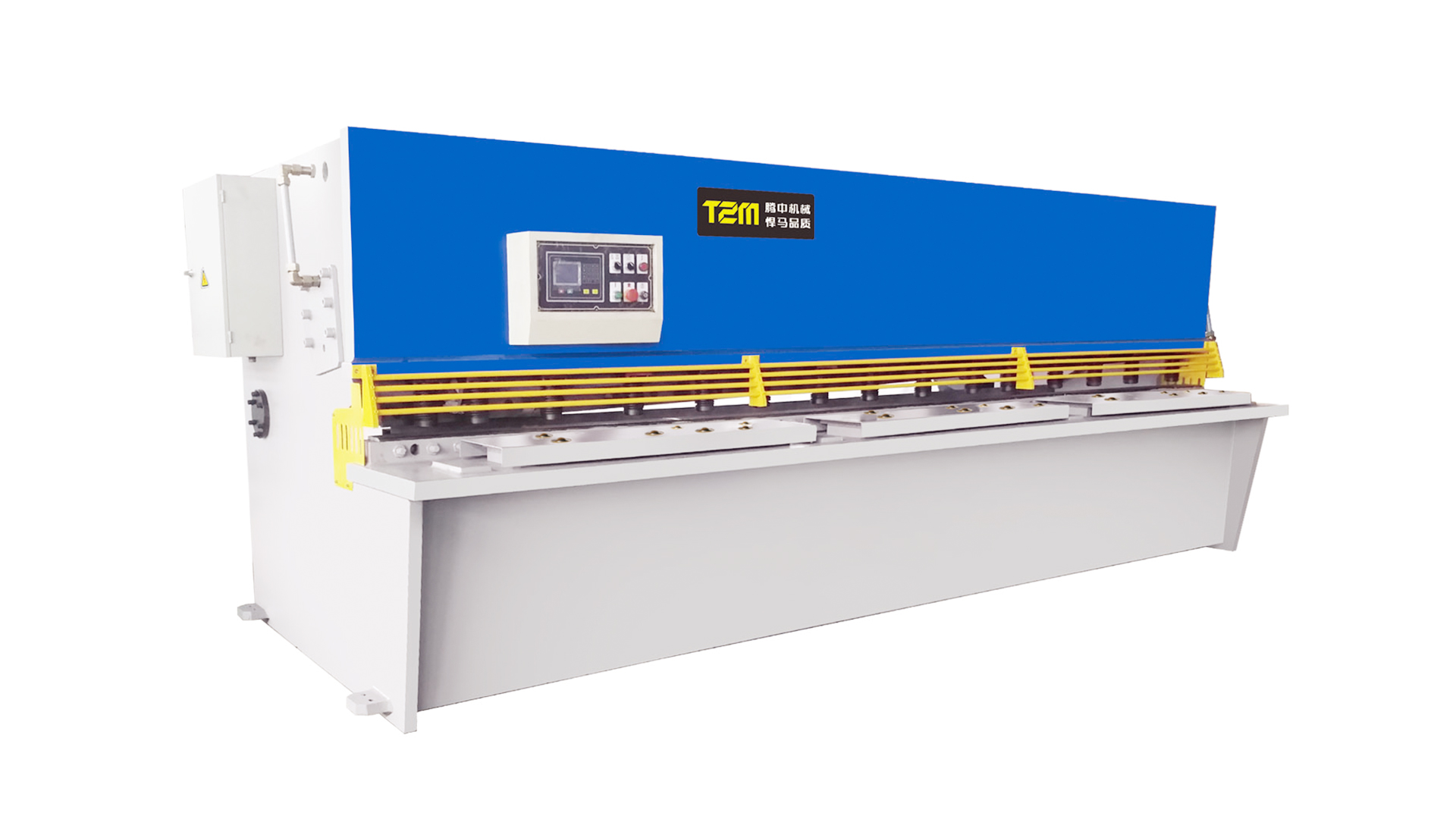
For a production-focused vertical configuration, our CNC vertical grooving machine includes a servo-driven Z-axis, a pre-loaded ball screw, and a reinforced table design for sheet sizes common in architectural metalwork.
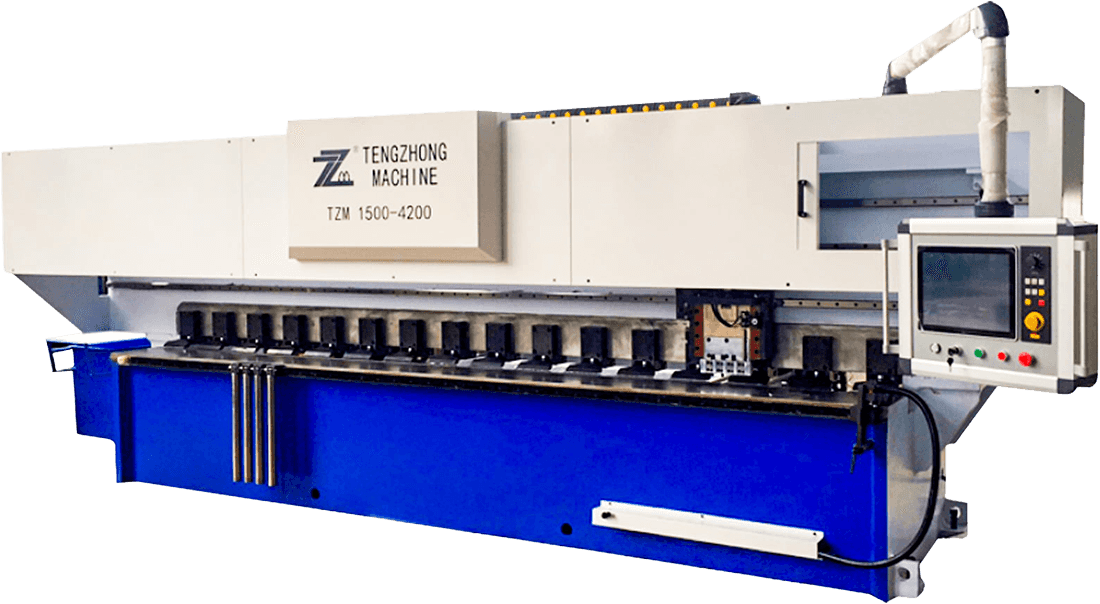 Custom CNC Vertical Grooving Machine Suppliers, OEM/ODM Company - Nantong TengzhNantong Tengzhong Machinery Manufacturing Co., Ltd. is China custom CNC Vertical Grooving Machine suppliers and OEM/ODM company, details:...View Product →
Safety, Maintenance, and Long-Term Performance
Grooving machines handle sharp metal chips and hold workpieces under heavy clamping force. Keep safety interlocks in place and follow a simple maintenance routine. The main objective is to keep depth calibration stable for years of production.
- Daily: Remove chips from the tool area and check that the clamping system holds the sheet without flex.
- Weekly: Inspect the cutting tool edge for burrs and confirm the tool holder is seated correctly.
- Monthly: Lubricate the linear guides, inspect the ball screw preload, and verify Z-axis calibration against a test piece.
- After each change-over: Use a depth gauge or step block; do not rely only on the screen value.
With regular attention, a CNC vertical grooving machine becomes a reliable step between cutting and bending. It turns a difficult forming operation into a repeatable one, and that is what makes it valuable in precision sheet metal production.

-
Phone
+86 131-4173-2687
-
Address
6 Jianghai Road,Libao Town, Haian. Jiangsu Province, China
-
Medla

Copyright o Nantong Tengzhong Machinery Manufacturing Co., Ltd. All Rights Reserved.
