
 English
 русский
 Français
 Español
 Português
 عربى
عربى

-


Model:
-

Model:
-

Model:

4 Roller Rolling Machine: How It Works, Key Benefits & Buying Checklist
2026-08-27
Content
Flat ends on a freshly rolled shell are the clearest sign that a shop is fighting its machine instead of working with it. Rolling 12 mm mild steel into 1,600 mm cylinders for a storage tank on a symmetrical 3-roll machine typically leaves a long straight strip at each plate edge, and every one of those edges needs a separate pre-bending setup with crane work in between. A 4 roller rolling machine eliminates that cycle: the plate is clamped between the top roll and a side roll, and both edges are bent to radius without the plate ever leaving the machine. The buying conclusion is direct. If your daily work involves plate thicker than about 8 mm, roundness tolerances measured in single millimeters, or frequent changeovers between jobs, the 4-roll configuration repays its higher price through less handling, less scrap, and shorter cycle times per shell.
How a 4 Roller Rolling Machine Works
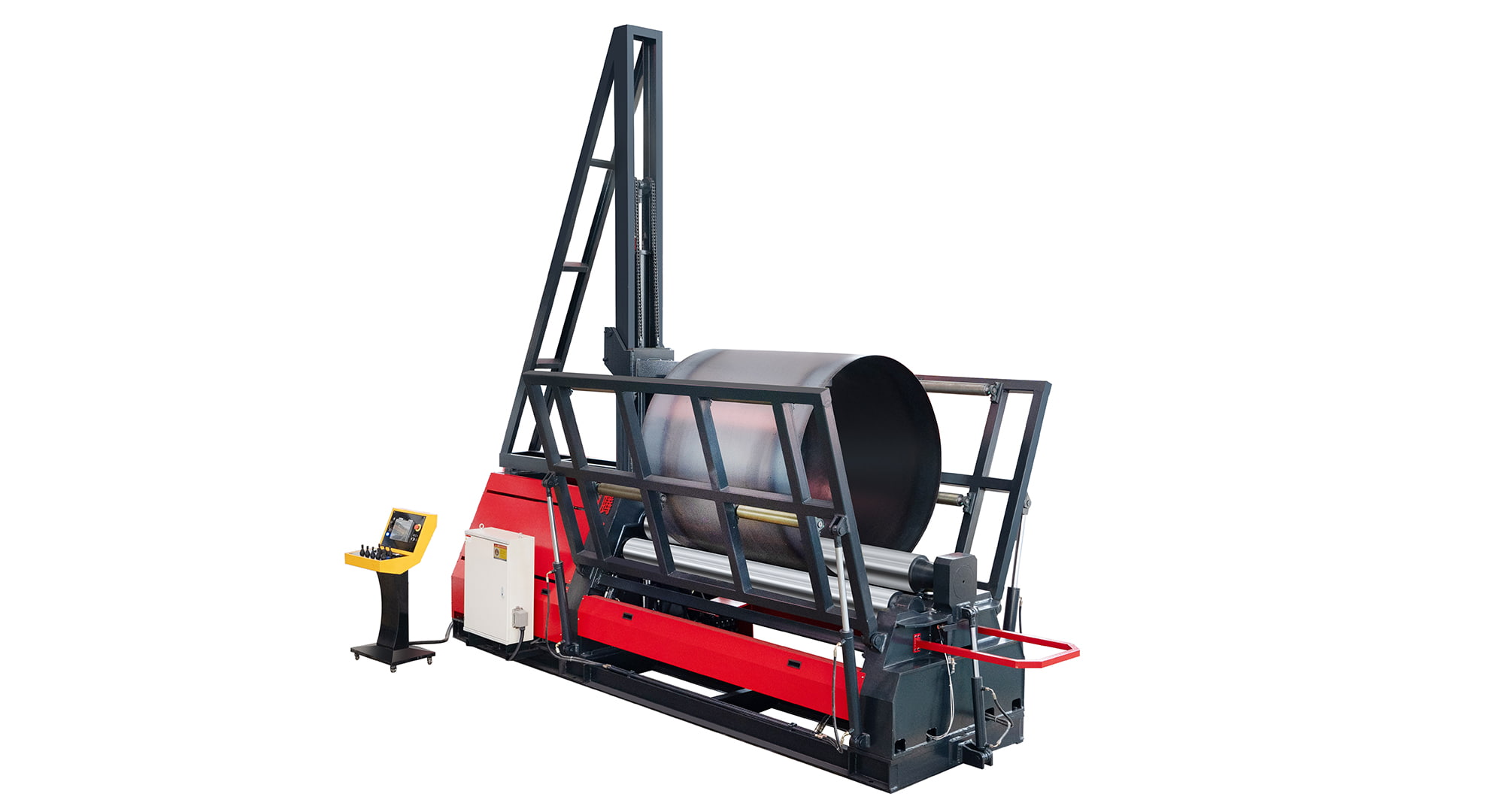
The roll stack is simple once visualized: one large top roll sits above two smaller side rolls, one on each side. During rolling, the top roll presses the plate down onto the near side roll, which grips and feeds the material. The far side roll travels upward on its slide and supplies the bending force from below.
A complete cycle runs in this order:
- The plate is fed squarely into the rolls, and the top roll clamps it firmly against the near side roll.
- The far side roll rises to the calculated pre-bend position and bends the leading edge to radius as the plate feeds forward.
- The plate rolls through until the trailing edge approaches the clamp point, then the side rolls swap roles and the second edge is pre-bent in the same setup, with no flipping or re-squaring.
- Both side rolls take up a shared radius position while the plate completes one or more full passes and closes into a cylinder.
Because the clamped edge cannot slip, every bend position is referenced to the plate itself rather than to operator judgment, which is why 4-roll machines hold roundness consistently across shifts and across operators. The mechanics of this edge forming are covered step by step in the guide to how the pre-bending function of a 4 roller rolling machine works.
4-Roll vs 3-Roll: Where the Difference Shows Up
A 3-roll machine is not a weaker tool; it is a different tool. The trade-offs surface as plate gets thicker and diameters get tighter. In daily operation, the differences come down to four points:
- Pre-bending: a 3-roll machine needs the plate removed, turned around, and re-aligned for the second edge, while a 4-roll machine pre-bends both edges in one clamped setup.
- Straight end allowance: a 3-roll typically leaves 1.5 to 2.5 times the plate thickness of unbent material per edge, against roughly 1 to 1.5 times on a 4-roll.
- Consistency: constant clamping makes 4-roll results far less dependent on operator skill.
- Cost: the fourth roll, its hydraulics, and the added control axes raise both the purchase price and the number of maintenance points.
| Factor | 3-Roll Machine | 4-Roll Machine |
|---|---|---|
| Edge pre-bending | Second edge requires removal and flipping of the plate | Both edges pre-bent in a single setup |
| Straight end length | About 1.5-2.5 times plate thickness per edge | About 1-1.5 times plate thickness per edge |
| Operator dependence | Higher, alignment relies on skill | Lower, plate stays clamped throughout |
| Best-suited work | Thin plate, trimmable edges, simple cylinders | Thick plate, tight tolerances, mixed batches |
| Purchase and upkeep | Lower cost, simpler hydraulics | Higher cost, more moving axes |
For light-gauge, cost-driven production where the straight ends can simply be trimmed off, a 3-roll hydraulic machine remains the more economical route.
3-roller hydraulic plate rolling machine Hydraulic 3 Roller Rolling MachineA cost-effective choice for light-gauge, high-volume rolling, this hydraulic 3-roll machine offers end pre-bending with a remaining straight edge under 2.5 times plate thickness, plus automatic electronic leveling.View Product →
Key Specifications to Check Before Buying
Spec sheets reward careful reading, and three numbers deserve more attention than the rest.
Thickness rating and yield assumptions
Capacity is always quoted against a reference yield, most commonly 245 MPa mild steel. Austenitic stainless work-hardens and effectively reaches 1.3 to 1.4 times that reference, so a machine rated at 20 mm of mild steel may manage only about 14 to 15 mm of stainless at full width. Always confirm that the rating applies at full working length, not just across a shortened central span.
Minimum rollable diameter
The smallest cylinder a machine can close is tied to the top roll diameter, usually around 1.1 to 1.2 times it. A 380 mm top roll therefore limits work to roughly 420 to 460 mm inner diameter. For shops making smaller shells or pipe, this single figure can decide the model.
Control and automation level
Configurations range from manual side-roll adjustment to full CNC control of every axis, with stored rolling plans for repeat jobs. On serial production of identical shells, CNC repeatability cuts first-article adjustment from several test passes down to one or two.
CNC 4-roller plate rolling machine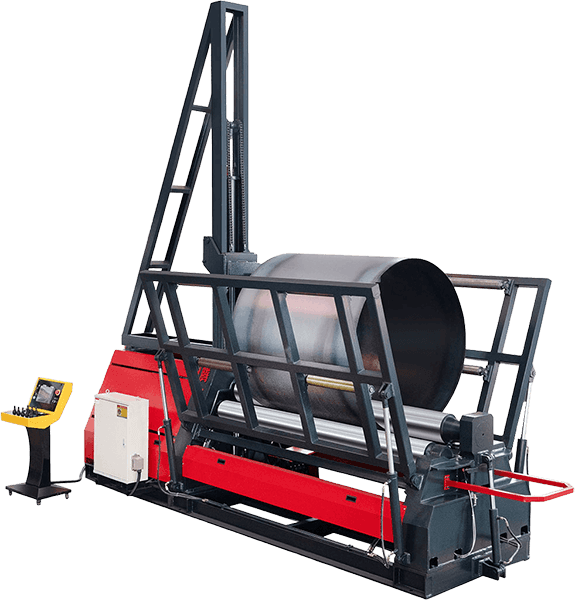 4 Roller Rolling MachineFor high-mix and serial production, this 4-roll machine delivers precise, repeatable rolling with PLC control, manual to fully automatic modes, and a 7-inch touchscreen for stored rolling plans.View Product →
That stored-program capability is what draws high-mix fabricators toward a CNC configuration once order volumes justify the step up.
Where 4-Roll Machines Earn Their Keep
Any plant building pressure vessels, boiler drums, wind turbine tower sections, or large-diameter pipe will have 4-roll machines at the center of its shell line. Shipyards use them for hull cylinders and heavy pipe; structural steel shops roll columns and tapered roof supports on them. The common thread is thick plate, welded longitudinal seams, and roundness that directly affects fit-up.
The material range is equally broad: structural and boiler-grade carbon steels, 304 and 316 stainless for sanitary and chemical work, and aluminum alloys, where roll surface finish and friction control matter most. Conical parts such as reducers and tank transitions are routine when the side rolls are set asymmetrically, though this geometry asks more from the setup than a plain cylinder does.
Getting Accurate Results on the Shop Floor
Even a well-built machine produces oval or bellied shells when the basics slip. Four habits separate consistent shops from frustrated ones:
- Check machine leveling and roll parallelism after installation and after any relocation, since a twisted frame imprints a spiral error into every shell.
- Clean the rolls before each shift; a chip or weld bead on a roll face dents a matching line into the plate and can mark stainless badly enough to require refinishing.
- Set roll gap and side-roll positions deliberately, because small parallel errors stretch one side of the plate and turn a planned cylinder into a cone.
- Write down working setups. Recorded side-roll positions turn a repeat order into a five-minute job instead of a trial-and-error session.
Conical rolling best illustrates how much technique matters. The side-roll offsets, feed direction, and end support used on a four-roller machine for conical heads follow established principles, and the article on roll adjustment for four-roller conical work walks through the method in detail.
Ownership Costs Worth Budgeting
Beyond the invoice, a realistic budget includes hydraulic oil changes on the manufacturer's interval, roll surface care on heavy stainless schedules, electrical servicing in dusty shops, and operator training. Machines with more servo axes add encoder and valve maintenance but repay it in setup time. Ask for the recommended first-year spare-parts kit at purchase, since seals, filters, and a pressure gauge cover most early surprises.
The decision narrows to three honest questions: how thick is the plate run weekly, how tight is the roundness requirement, and how often do jobs change over? Thick plate, demanding tolerances, and high turnover all point to the 4-roll configuration, where clamped, repeatable rolling protects both quality and throughput. Light-gauge work with generous edge trim still belongs to the 3-roll machine. Buy for the plate handled every week rather than the single heaviest job ever quoted, and the machine repays the choice in shells that close round on the first pass.

-
Phone
+86 131-4173-2687
-
Address
6 Jianghai Road,Libao Town, Haian. Jiangsu Province, China
-
Medla

Copyright o Nantong Tengzhong Machinery Manufacturing Co., Ltd. All Rights Reserved.
